Timiskaming First Nation Language Resource Page

ATFN Algonquin Keyboard

This is the link to the keyboard built for the community

Timiskaming First Nation Language Resource

A central place for language learning resources, events, and community-led initiatives.

FAQ - Understanding Anishinābemowin / Algonquin Language Variation

Language Resources

Anishinābemowin can be translated roughly as “the way that the Anishinābe people speak.” This word comes from inside the language itself. It is the name that speakers use to describe their own language. Because Anishinābemowin means ‘the way the Anishinābg speak’, technically anything spoken by the Anishinābe peoples is Anishinābemowin, even though these might be spelled or pronounced a little differently from place to place: Anishiniimowin, Nishnaabemwin, Anishnabemowin, etc. Those who identify as Anishinābe speak some form of Anishinābemowin.

Many of the labels used in English and French—such as Algonquin and Ojibwe—are external names. These were usually created by non-Anishinābeg to refer to different groups of Indigenous peoples. Over time, these externally given names were also used to refer to the languages spoken by those groups. Linguists use the names Algonquin, Ojibwe, Odawa, Potawatomi, etc., as a label to be able to talk about a specific kind of Anishinābemowin usually spoken in a specific place—but they are all still kinds of Anishinābemowin. All of these different kinds of Anishinābemowin varities form what we call a dialect continuum–a chain of closely related varieties of a language over a specific geographic area. Each community speaks in a slightly different way, but neighbouring communities can  usually still understand each other easily because the differences are usually small.

Here is a really good map that shows what the dialect continuum for Anishinaabemowin and some related languages looks like:
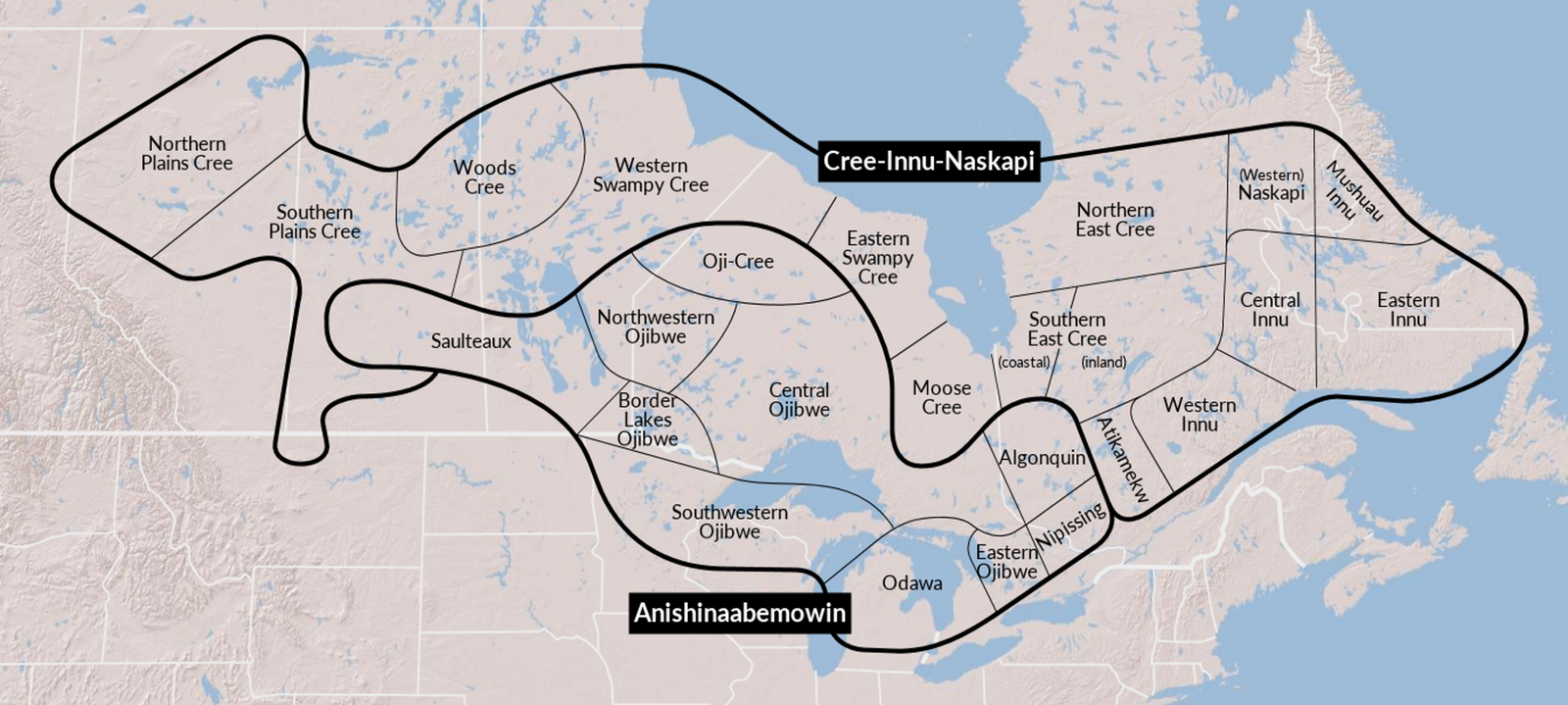

Dialect continuum of Anishinâbemowin and related languages

Oxford, Will. 2023. Algonquian language maps. Manuscript, University of Manitoba. http://home.cc.umanitoba.ca/~oxfordwr/algling/maps.html.

As you travel farther along the chain, the differences gradually add up, so that communities very far apart may find each other less understandable — even though there is no clear boundary where one language ends and another begins. So, someone who speaks “Algonquin” may understand someone who speaks “Ojibwe” or they may also understand speakers of Atikamekw, or even Oji-Cree.

From a linguistic perspective, Algonquin is the term used to describe one particular kind of Anishinābemowin on that dialect language continuum.

Because all of the Algonquin communities are on a language continuum like we described in the first question, the language spoken in different places will not be exactly the same, but speakers from nearby communities can usually understand each other, even if there are small differences.

The differences that we expect to see from community to community include:

  • Vocabulary — different words for the same thing
  • Pronunciation — slight shifts in how sounds are produced
  • Writing systems — communities may choose different ways to write the same sounds

Remember that each individual person also has their own way of speaking and writing. All of these differences are normal and expected.

Remember that all of the languages in this continuum were originally oral languages. They were spoken, passed down, and maintained without writing. (And actually, this is true for most of the world’s languages!)

Algonquin was written down by the French sometime before 1661. The earliest writing systems for Algonquin were developed by French speakers, who used the Roman alphabet to approximate the sounds they heard. (You can find out a little bit about this at this link:  ASSM Manuscript 103). Many communities still use this French-based spelling system or variations of it.

Over time, communities developed their own writing systems, for different cultural, educational, and practical reasons. Examples include:

  • Macrons (ā ē ī ō) — used to mark long vowels
  • “c” or “8” — features of older French-based spelling traditions
  • Locally developed orthographies — created to support teaching and learning in specific communities

All of these systems are valid. They are all ways of writing Algonquin or other varieties of Anishinābemowin. The differences simply reflect different historical influences and community preferences.

You can find out more about the system Timiskaming First Nation uses in the Sounds and Writing section of this website.

Differences in speaking or writing can come from geography, community history, or individual preference. These are not wrong—they are normal. Variation happens:

  • Between regions (for example, Algonquin vs. Ojibwe vs. Oji-Cree)
  • Between communities (for example, the different writing systems used between Algonquin communities)
  • Between individual speakers (just like in English or French)

What matters most is the ability for people to understand each other, and having a shared community standard so that teaching and learning are consistent and clear. 

Stuck on the difference between Anishinābemowin and Anishinaabemowin? Want to know more about macrons? Contact us at Rebekah.Ingram@atfn.ca

Announcements

Updates from the Language Learning Centre will appear here.